— PoCC v0.1

DECENTRALIZED
GPU COMPUTE
FOR AI

Miraset Chain is a Rust-based, compute-first blockchain that pays GPU operators to run verifiable AI inference. Inference executes off-chain on real hardware; jobs, balances, and rewards settle on-chain. One rule: prove capacity, prove compute, get paid.

Consensus
PoCC
Node
Rust, native
Settlement
On-chain

What it is

A CHAIN BUILT
AROUND GPU WORK,
NOT SMART CONTRACTS

Miraset Chain is a Rust-based, compute-first Layer-1 blockchain that connects GPU providers with AI inference consumers. Jobs run off-chain on real hardware; receipts, balances, and rewards settle on-chain. The result is a decentralized marketplace for AI compute with verifiable settlement and minimal attack surface.

The state model is object-centric, implemented in Rust, and the chain exposes only native protocol transactions — no smart contracts, no unnecessary attack surface. Consensus rewards both capacity and compute, so the network stays live and useful even when traffic is low.

  • Nodemiraset-node (Rust)
  • StorageSled
  • HashingBlake3
  • SignaturesEd25519

How it works

PROOF OF COMPUTE
& CAPACITY

PoCC rewards both capacity (keeping GPUs online) and compute (verifiable inference work, measured in tokens processed). This dual incentive keeps the network useful even when traffic is low.

  • WORKERS

    capacity + compute

    GPU node operators register their hardware (VRAM, GPU model, supported models), run a local inference engine, execute jobs assigned by the coordinator, and submit cryptographic receipts to earn rewards for capacity and compute.

  • USERS

    inference consumers

    AI inference consumers submit prompts, model selections, and parameters. They receive streamed responses from assigned workers and pay per-token pricing for consumed compute, settled on-chain.

  • COORDINATOR

    MVP — evolving

    An MVP scheduler that matches jobs to capable workers, monitors execution, and optionally co-signs receipts. The roadmap explicitly evolves this role toward full decentralization post-MVP.

  • VALIDATORS

    PoCC consensus

    Network validators participate in PoCC consensus, finalize blocks and epoch transitions, and distribute rewards based on verified capacity and compute contributions.

Why use it

BUILT FOR REAL
AI WORKLOADS

  • Cost-efficient inference

    Tap into idle GPU capacity worldwide. Pay less per token for high-volume AI inference than on centralized providers.

  • Decentralized AI

    Censorship-resistant, always-available AI inference powered by a global operator network and settled on a blockchain.

  • GPU monetization

    Turn idle gaming rigs and data-center GPUs into passive income by contributing verifiable capacity and compute to the network.

  • Privacy-preserving

    Data sovereignty with verifiable execution and on-chain receipt commitments — proofs of work without exposing inputs.

  • Research & education

    Democratized access to AI infrastructure for researchers, students, and open-source projects, billed per token.

  • Enterprise deployment

    Scalable AI inference without capital expenditure, billed per token and settled on chain — OpEx, not CapEx.

USE CASES

From individual GPU owners to enterprise teams — one chain, one settlement layer.

  • 01

    Cost-efficient AI inference

    50–70%cost reduction
  • 02

    Decentralized AI services

    24/7availability
  • 03

    GPU monetization

    IdleGPUs earn
  • 04

    Privacy-preserving AI

    On-chainreceipts
  • 05

    Research & education

    Openinfrastructure
  • 06

    Enterprise AI deployment

    OpExno CapEx
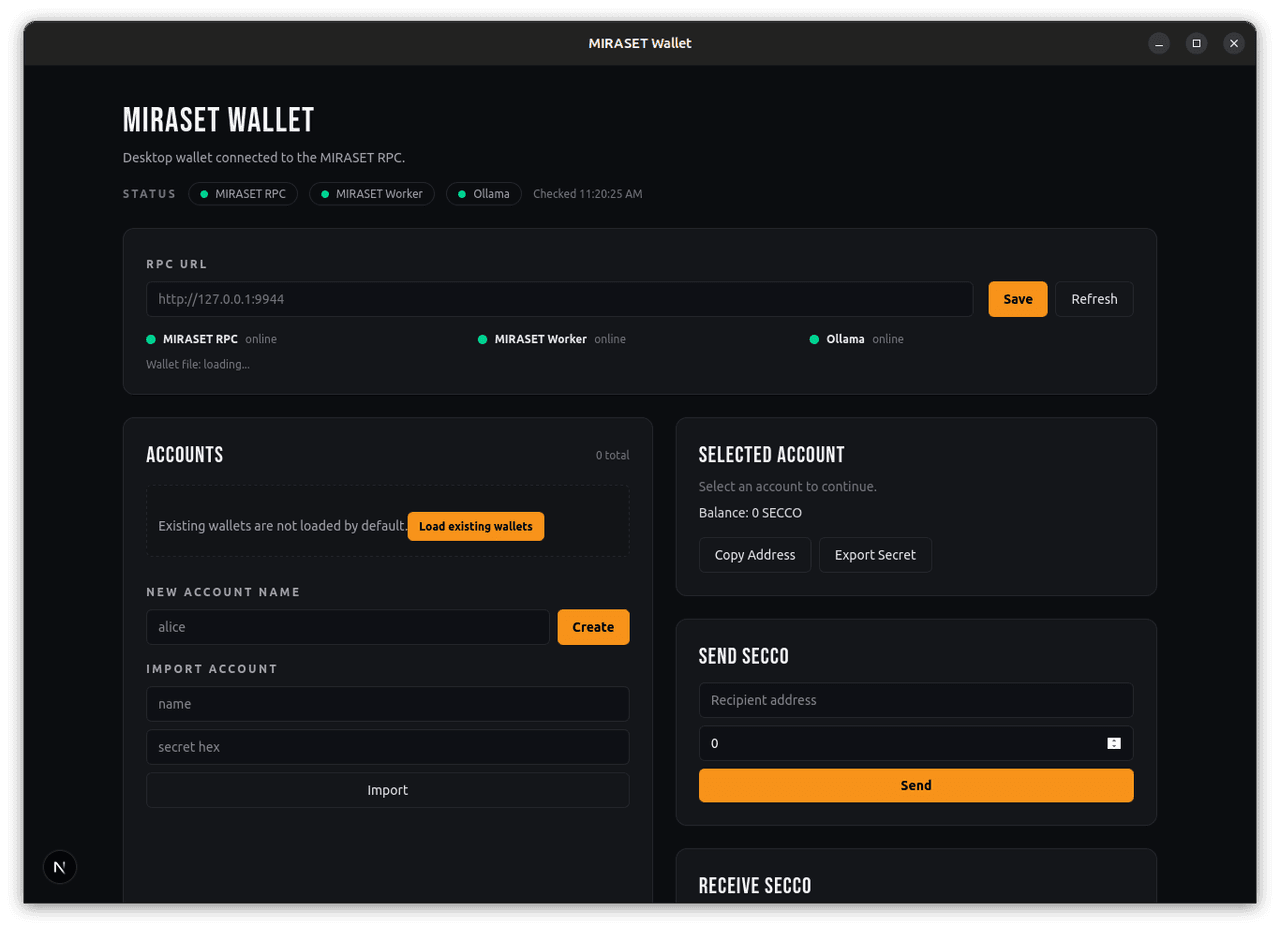
MIRASET Wallet desktop application screenshot showing accounts, worker status, and inference job submission
MIRASET Wallet desktop client

Reference wallet

ONE WALLET
NODE. WORKER
ONE UI

The MIRASET Walletis the reference desktop client. It connects to the RPC, runs a worker, manages accounts, and submits inference jobs — all from the same control panel.

  • RPCConnected to local node
    online
  • WorkerInference runtime active
    online
  • OllamaModel backend ready
    online

Architecture

ON-CHAIN
SETTLEMENT
OFF-CHAIN
INFERENCE

Workers run real inference. The chain settles it. Receipts are hashed on-chain as ReceiptAnchor objects, signatures verify the work, and rewards are distributed at every epoch.

modules
crates/
  • 01

    miraset-node

    Blockchain node, PoCC consensus, settlement, RPC.

    on-chain
  • 02

    miraset-core

    State types, signatures, hashing, serialization.

    on-chain
  • 03

    miraset-worker

    Inference runtime, Ollama backend, job execution.

    off-chain
  • 04

    MIRASET Wallet

    Reference desktop client: accounts, jobs, monitoring.

    client
$ cargo build --release

Roadmap

WHERE
WE'RE
HEADED

MVP is live. The path to a fully decentralized scheduler and hardened mainnet is open and tracked publicly on GitHub.

  1. 01

    MVP chain & worker

    Rust node, object-centric state, basic PoCC, mock inference fallback.

    in progress
  2. 02

    Reference wallet

    Desktop wallet: accounts, RPC config, worker control, job submission.

    in progress
  3. 03

    End-to-end marketplace

    Full job marketplace settlement with epoch batching and dispute flows.

    next
  4. 04

    Hardened verifiability

    Canonical receipt serialization, challenge flows, deterministic hashing.

    next
  5. 05

    Decentralized scheduler

    Evolve from the permissioned coordinator toward full decentralization.

    next
  6. 06

    Mainnet hardening

    Harden native asset, job, and settlement flows before public launch.

    next

FAQ

QUESTIONS,
ANSWERED

Quick answers to the most common questions about Miraset Chain, the PoCC consensus mechanism, and the reference wallet.

What is Miraset Chain?

Miraset Chain is a Rust-based, compute-first Layer-1 blockchain that rewards participants for providing GPU capacity and executing AI inference workloads. It settles jobs on-chain while inference runs off-chain on real GPU hardware.

What is Proof of Compute & Capacity (PoCC)?

PoCC is Miraset's consensus mechanism. It rewards validators for two things: capacity (keeping GPUs online and available) and compute (verifiable inference work, measured in tokens processed). This dual incentive keeps the network live even when traffic is low.

How does Miraset keep inference verifiable?

Workers produce deterministic receipts for each inference job. Receipts are hashed on-chain as ReceiptAnchor objects and signed by the worker (and optionally the coordinator). Anyone can later verify that a piece of work was performed.

What can I do with a Miraset worker?

Any GPU operator can register hardware (VRAM, GPU model, supported models), run the local inference engine, execute jobs assigned by the coordinator, and submit cryptographic receipts to earn rewards for capacity and compute.

Does Miraset support smart contracts?

No. Miraset exposes only native protocol transactions and a small set of core object operations. This keeps the attack surface minimal and makes settlement deterministic.

What is the MIRASET Wallet?

The MIRASET Wallet is the reference desktop client. It connects to a local node RPC, runs a worker, manages accounts, and submits inference jobs — all from one control panel.

How much does it cost to run a worker?

Miraset itself is open-source and free. You only pay for your own hardware and electricity. Earnings depend on uptime, GPU capacity (VRAM), and tokens processed.

Where can I read the code and contribute?

Everything is open source at https://github.com/miraset/miraset-chain. Issues, pull requests, and feature proposals are welcome.

TALK TO THE
BUILDERS

For partnership, integration, validator questions, or anything that does not fit a GitHub issue, reach the Miraset team directly. Bug reports and feature requests stay on the issue tracker.

OPEN SOURCE
BUILT IN RUST

Explore the code, file issues, propose features, or run your own node. Miraset is open source and welcomes contributors.